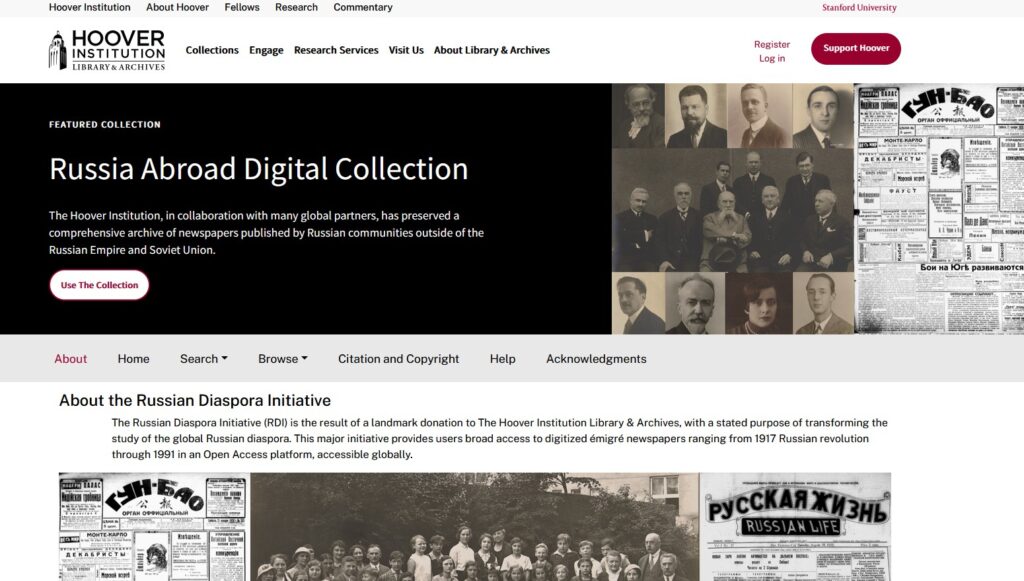
Hoover Institution Library & Archives, Russia Abroad Digital Collection, <https://radc.hoover.org/?a=p&p=about&e=——-en-10–1–img——-> (14. I 2025).
Istraživačima istorije ruske emigracije, prve masovne političke emigracije savremenog doba, od kraja 2024. godine na raspolaganju je još jedan važan digitalni resurs. Кolekcija digitalizovanih novina ruske dijaspore (1917–1992) Biblioteke i arhiva Huverovog instituta trenutno sadrži preko pola miliona stranica iz pedeset četiri publikacije koje potiču iz zemalja domaćina u kojima su se nastanili ruski emigranti i formirale izbegličke zajednice. Imajući u vidu da se posle 1920. godine preko dva miliona ljudi razvejalo po Evropi i svetu, formirajući jedinstvenu društvenu grupu „Zagranične Rusije”, digitalni korpus ruskih izbegličkih novina, pretraživ prema naslovu, zemlji, mestu i datumu objavljivanja, svakako predstavlja vredan poduhvat. Digitalna kolekcija novina koja obuhvata kako glavne dnevne publikacije, tako i političke, vojne, kulturne, književne i druge publikacije, u svom konačnom obliku planira da obuhvati tri stotine naslova iz tridesetak različitih zemalja. Zbirka je većim delom u formi otvorenog pristupa, dok je samo za pojedine sadržaje ograničen pristup zbog ugovora o autorskim pravima. O tome da je izbeglička svakodnevnica nametala različite potrebe za informacijama svedoči i podatak da je samo u Kraljevini Jugoslaviji u međuratnom periodu izlazilo preko dve stotine novina i drugih periodičnih publikacija na ruskom jeziku. Istina, retka od ovih izdanja su uspevala da požive duže od godinu-dve. Za sada je na ovom mestu sa jugoslovenskog prostora dostupna jedino kolekcija lista Ruski glas (Russkiй golos), koji je izlazio nedeljno u Beogradu od 1931. do 1941. godine.
Biographical Sources for the Russian Emigration History at the Historical Archives of Belgrade Author: Slobodan Mandić
Russian immigration in the Kingdom of Serbs, Croats and Slovenes represents a complex historical and social phenomenon, equally significant for the history of the Balkans, Russia, Europe and world history as well. On the other hand, Belgrade is righteously considered to be significant international archival center for researching various modern history phenomena including history of Russian immigration, a process that turned out to be the most massive interwar political immigration.[1] Among institutions which preserve valuable archival material important for reconstructing history of Russian immigration after revolution in 1917 and Civil war from 1918-1920 in Soviet Russia, Historical Archives of Belgrade is certainly highly positioned.[2]
Historical Archives of Belgrade preserves today about 2800 fonds and collections, that is 13 linear kilometers of archival material, which covers the period from 16th century until today. The oldest fond is Zemun Magistracy (1749–1934), and oldest individual document is Dialogue between an Ottoman Turk and a Christian from 16th century. Most of the fonds cover the field of economy and finances, then social and political institutions and societies, education, culture, science and public services, health and social care, judiciary services and religious institutions. Numerous are also personal and family fonds, legacies and collections.
In this paper we will mention the most important archival fonds and collections, important for researching personal data of Russian immigrants for the period between 1920 and 1950. Great number of Russian refugees situated in Belgrade doubtlessly left significant traces in archival documents and certain collections represent particularly important sources for biographical data on Russian immigrants. When it comes to possibilities of using archival documents in future, it is necessary to have in mind great potentials of implementation of new technological solutions, inside the Archives as well as in the process of data exchange and various forms of co-operations between different institutions.
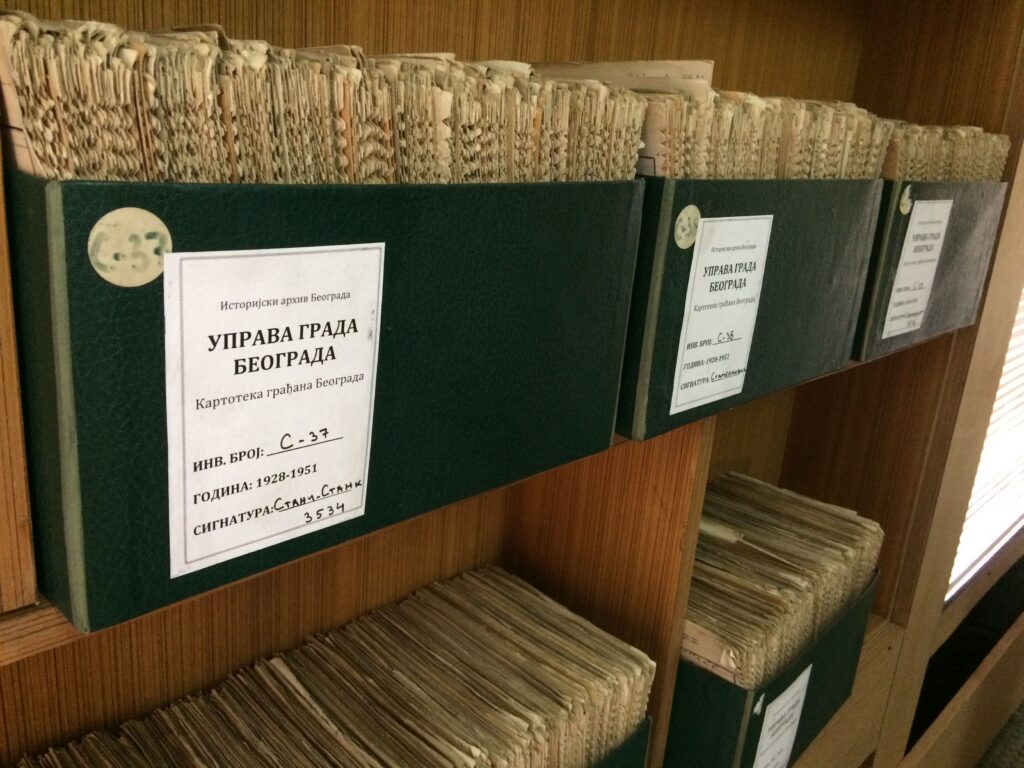
The most important archival fond which contains the biggest number of biographical data on Russian refugees is certainly Card Register of Belgrade and Zemun Citizens of Central Application Office of Belgrade City Administration kept from the beginning of the 1920s until the end of the 1940s.
Card Register of Belgrade and Zemun Citizens is a part of the fond Belgrade City Administration (UGB) 1839-1944 preserved in the Historical Archives of Belgrade. The fond covers the period from 1924 until 1944 (but the cards were kept until 1950s); it is placed in 848 cardboard boxes (755 with Belgrade citizens and 93 with Zemun citizens). Total number of cards is over one million; they are arranged within the boxes in alphabetical order. The cards are printed on both sides; dimension of the card is 21x19cm. They all have the same entry fields for personal data and not all were necessary to be filled in. The cards were filled in by hand, in ink, which should be considered during the internal critical analysis of the data.
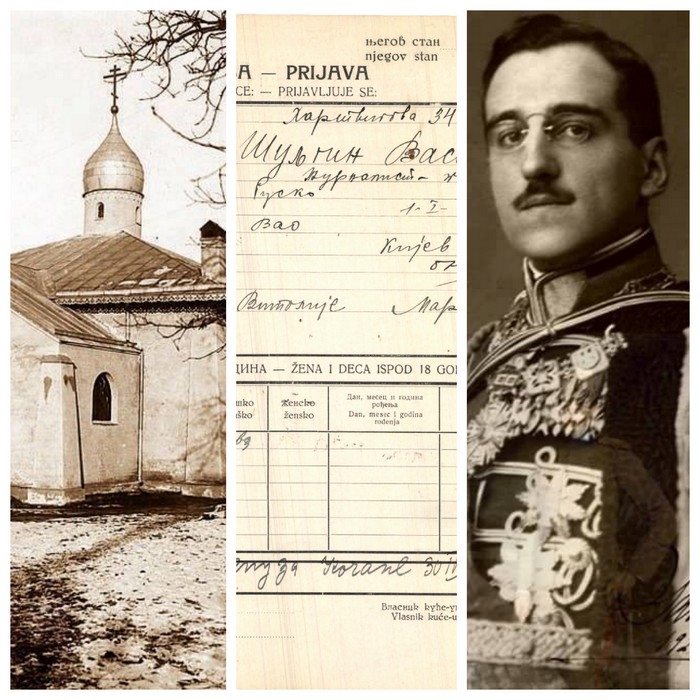
The cards with their data structure represent inexhaustible source for researches of demographic characteristics of the capital of the Kingdom of Serbs, Croats and Slovenes/Yugoslavia and later of the Federal People’s Republic of Yugoslavia. Data available on the cards are: address; first and last name; profession; citizenship; date of birth; place of birth; origins – municipality, county, country; confession; previous residence; name and maiden name of a wife[3]; name/s of a child/children; personal description for foreign citizens; residence registration with date, address and name of the landlord; date of the deregistration and new destination; every card has the field remark, that often contains additional information.
It is well known that primary sources used to reconstruct the history of Russian immigration in the Balkans, despite the fact that they are well preserved, show certain limitations. Professor Miroslav Jovanovic pointed out that the fonds of immigrants’ organizations and institutions, as well as fonds of government offices in charge of the immigrants, are very rich in archival material created from the beginning of 1920s until 1925-26. After that period, the amount of archival material is reduced.[4] Card Register of Belgrade and Zemun Citizens kept in the Historical Archives of Belgrade, as a specific kind of archival material created by government authorities, surely has certain degree of reliability and can fill in the gaps after 1926, when documentation of the government authorities and of immigrant institutions suddenly diminish, especially after their problems with residence had been resolved. Registration cards document the period when the immigrants integrated in new environment.
Results of the conducted research on prominent individuals of the February Revolution, members of political and military elite of the Russian Empire situated in Belgrade, identified in the Card Register of the Belgrade and Zemun citizens 1924-1950[5], first of all demonstrate a new dimension of this archival material when it comes to the research of the history of Russian immigration. Also, results of the research on significant individuals from Russian immigration and year 1917 indicate another quantitative characteristic of data preserved in over one million registration cards of Belgrade citizens. The research results show great number of Russian immigrants who came to Belgrade; and the number of immigrants was increasing even in the period when their number in the Kingdom was reduced. Total number of Russian immigrants in the Kingdom of Serbs, Croats and Slovenes in the period between 1921 and 1924/25 was reduced from 40.000 to 35.000, and in Belgrade this number was increased from 3.500 to 10.000 emigrants[6] (population of Belgrade in 1931 was 239.000). These numbers show that it is possible to research many aspects of Russian immigration history on a large sample of those who were registered in Belgrade and whose register cards are today kept in Historical Archives of Belgrade.
We shall mention only few aspects of Russian immigration history which can be additionally researched through the citizen card register. For example, due to information about previous residence, date of deregistration and next destination, it is possible to track process of refugees moving away, which was one of the constants in their lives in the Balkans.[7] One of the reasons why the immigrants sought life in metropolis was because only in big city they could have found an intellectual career, even though many of them were ready to accept any employment. Russian soldiers and army officers had the most difficulties in finding employment, which can be seen in the registration cards of Russian imperial army generals: Petr Ivanovich Averyanov, Vladimir Pavlovich Shatilov, Mikhail Alekseevich Przhevalsky. General Averyanov, last Head of the Headquarters of Russian Imperial Army, first worked in cadaster, then he was Professor of Mathematics in Gymnasium in Ćuprija and then he transferred to the History Department of the Army Headquarters in Belgrade. General Shatilov was employed as a private clerk and General Przevaljski was a clerk in the Ministry of War. Also, detailed information on immigrants’ family members allow us to look deeper into their lives, collapses, challenges and problems that Russian immigrants had to face as individuals, families and as a community.[8]
A fact that should also be considered is that a number of Russian immigrants in Belgrade was probably not registered in the citizens’ Card register for various reasons: for example, for leaving Belgrade before 1924, for avoiding to register by the police authorities, or maybe a card was not preserved.
There are also some cases when one person was registered twice. That was the case with Mihail Borisovich Maksimovic, who was registered in April 1924 as Seminary student. The same person was registered on 14th January 1938 under the name Jovan Borisovich Maksimovic, bishop of Shanghai.
Card Register of Belgrade and Zemun Citizens kept from 1924 until 1950, with over one million registration cards, was scanned in 2016. This has simplified their everyday use. In previous decades, there has always been a possibility that certain card would not be put in the correct place, since it was arranged in alphabetical order, and this would be the same as if it were lost for good. If the process of digitization of the Card Register involved searchable database with all data from the cards available, future research of the Russian emigration would be so much facilitated and it would be possible to analyze new aspects of emigration on a representative sample.
Equally important historical source when it comes to biographical data on Russian immigration is archival material created by German occupying authorities and Serbian collaborating institutions in the Second World War. This archival material is preserved in fond Administration of the City of Belgrade and in fond Commander of security police and security service – BdS (material created by German political police which controlled the capital city and most part of Nedic’s Serbia). Also, concentration camp on Banjica was established during the war as a department of the Administration of the City of Belgrade by a decision and directive of German authorities.[9] Archival material preserved in Special Police department (personal records of agents and employees of Special Police and records of arrested persons), material created by German political police (personal records of arrested persons, register of arrested persons and persons followed by Gestapo) and personal data from Banjica Concentration Camp books are full of important information on Russian immigrants. These documents illustrate in the best way fate of Russian immigration during Second World War: some immigrants become members of Russian Protective Corps, some left Belgrade for concentration centers of Vlasov army, others became agents or officials of Special Police and Gestapo, and some were interrogated and arrested for their left wing political views. As many other Belgrade citizens, they were also arrested, taken to Banjica camp, shot or taken to other German camps.[10] It is estimated that within these fonds there are information for about 400 Russian immigrants.
Good example for possibilities that offer fonds from Second World War is the case of biographical lexicon of members of Russian Protective Corps (Moscow 2001).[11] Lexicon contain information for 3582 members of Russian Corps and only few members are registered in the material preserved in Historical Archives of Belgrade. But at the archival collections preserved in Historical Archives of Belgrade exists information for more persons, who were members of Russian Corps.
In the end, it would be useful to mention several other fonds with biographical information on Russian immigrants. Information about Russians employed in public services can be found within Personal departments of these institutions or in the employees’ list. For example, Municipality of the City of Belgrade keeps lists of Russian immigrants employed in the Municipality.[12] It is necessary to mention the fond of the Commercial Court in Belgrade and fond of Commercial intelligence Agency of Belgrade (Kredintinform). Also fragments of immigrants’ lives are preserved in the records of Commercial Chambers, Medical Chambers and in the records of Chamber of Crafts in Belgrade. Significant information can be found in the Technical direction department of the Municipality of the City of Belgrade. This material is arranged by the names of the streets and it preserves all information on the building in certain street, name of the owner, number of parcel and construction permissions.
[1] Russian immigration between the two world wars was thoroughly researched by Miroslav Jovanovic in his book Руска емиграција на Балкану 1920-1940, Belgrade, 2006.
[2] It is important to mention other Belgrade institutions significant for researching the Russian immigration: Archives of Serbia, Archives of Yugoslavia, Archives of Serbian Academy of Science and Arts, Archives of Serbian Orthodox Church, National Library of Serbia, University Library.
[3] Sometimes it is written the date of a marriage or marriages if the person as married more than once and also date and place of wife(s)’s birth.
[4] Мирослав Јовановић, Руска емиграција на Балкану 1920-1940, Чигоја штампа, Београд, 2006, p. 19-20.
[5] See: Slobodan Mandić, ”Russian Emigration and Year 1917 in the Collections of the Historical Archives of Belgrade: Participants of the February Revolution in Belgrade”, у: 1917 год в истории и судьбе российского зарубежья: Международная научно-просветительская конференция, Москва, 26–28 октября 2017 года, p. 517-532.
[6]Later, number of Russian immigrants in Belgrade started to diminish: in 1929/30 about 9.432 emigrants lived in Belgrade, in 1941/42 about 6.500. See М. Јовановић, Досељавање руских избеглица…, pp. 186, 218-219.
[7] Мирослав Јовановић, Руска емиграција…, p. 150.
[8] See Мирослав Јовановић, Руска емиграција…, pp. 470-477.
[9] Евица Мицковић, Милена Радојчић, ”Концентрациони логор Београд – Бањица у окупраном Београду – архивска грађа”, у: ЛогорБањица / Логораши 1941-1945, Историјски архив Београда, Београд 2009, p. 50-58.
[10] Бранка Ракочевић, Олгица Латинчић, Руски емигранти у Београду, траг и инспирација, каталог изложбе, Београд 1996. See also: Алексеј Тимофејев, Руси и Други светски рат у Југославији 1941-1945: утицај СССР-а и руских емиграната на догађаје у Југославији, Институт за новију историју Србије, Београд, 2011.
[11]Волков С. В., Стрелянов (Калабухов) П. Н, Чины Русского Корпуса, Рейтар, «Форма-Т», Москва 2009.
[12] ИАБ, ОГБ Општe одeљeњe, Административни одсeк, 1923, Ин. Б. 52, ф. 21, Р. бр. 292.
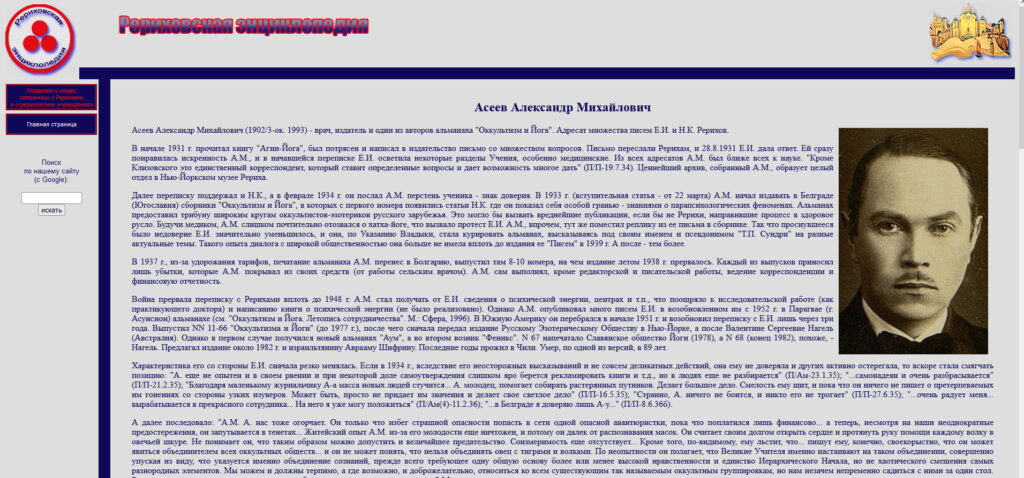
Рериховская энциклопедия <http://www.roerich-encyclopedia.facets.ru> (2. X 2022).
Aleksandar Mihailovič Aseev (1902/3-ок. 1993), lekar, izdavač i jedan od autora almanaha ”Okultizam i joga”, koji je izlazio u Beogradu od 1933, jedno vreme u Sofiji (1937/38), a od 1952. do 1977. u Paragvaju.
Intеrnеt prеzеntacijе posvеćеnе pojеdinim istorijskim ličnostima mogu biti vеoma zgodno i korisno srеdstvo u еfikasnom i brzom prikupljanju nеophodnih podataka i njihovim uporеđivanjеm sa drugim izvorima. Upoznavanjе sa bogatim i zanimljivim životom ruskog slikara, filozofa, naučnika i pisca Nikolaja Rеriha (1874–1947), kao i životom njеgovе suprugе i slеdbеnika, umnogomе jе olakšano postavljanjеm web sajta na ruskom jеziku čiju okosnicu čini prikupljеna i provеrеna istorijska građa sa raznih strana, prеthodno objavljеna kao prvi tom Enciklopеdijе Rеriha u Novosibirsku 2003. godinе. Prеzеntacija skromnog dizajna, ali jеdnostavnog i upotrеbljivog sadržaja, sastoji sе od nеkoliko sеkcija dostupnih putеm mеnija sa lеvе stranе еkrana. Posеtioci sе ovdе mogu upoznati i prеtraživati informacijе u vеzi sa licima koja su povеzana sa Rеrihovima, a mеđu kojima ima vеoma zanimljivih ličnosti i za istraživačе našеg podnеblja, poput Alеksandra Mihailoviča Asееva (1902/3–1993), lеkara, izdavača i jеdnog od autora almanaha Okultizam i joga, koji jе pokrеnut u Bеogradu 1933. godinе. Tu jе zatim i rеčnik s objašnjеnjima pojmova i imеnima koja su pomеnuta u dеlu Učеnjе živе еtikе, kao i analiza izdanja ovog dеla. Korisni su i odеljci koji sadržе bibliografijе o Rеrihovima i katalog slika N. K. Rеriha, vеoma plodnog autora, čijе su mnogе slikе izložеnе u poznatim svеtskim muzеjima i galеrijama.
Originalno objavljeno u Godišnjaku za društvenu istoriju 2, 2022, str. 102-103.
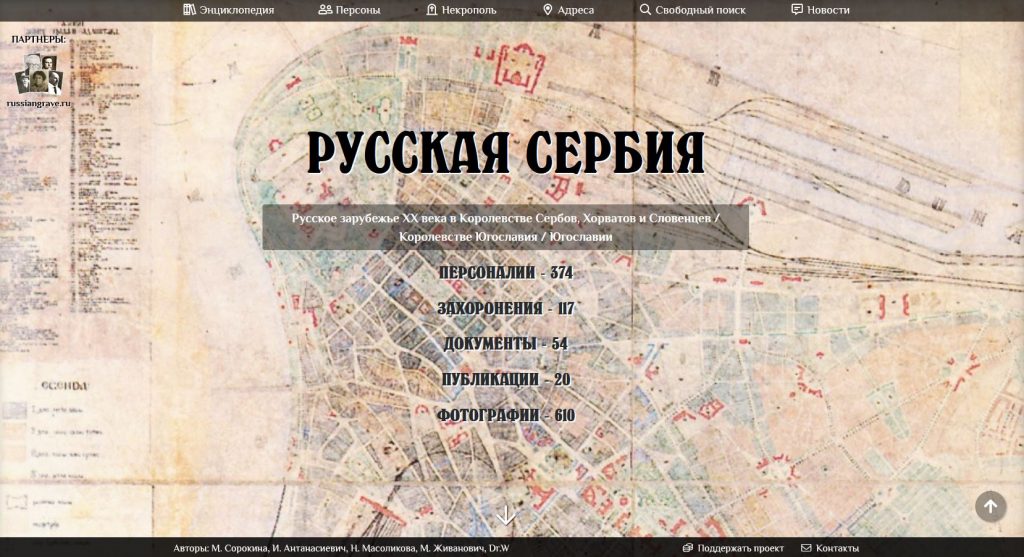
М. Сорокина, И. Антанасиевич, Н. Масоликова, М. Живанович, Dr.W, Русская Сербия<https://russianserbia.com> (8. II 2021).
U periodu između dva svetska rata Kraljevina Srba, Hrvata i Slovenaca/ Kraljevina Jugoslavija postala je jedno od središta ruske emigracije u Evropi. Zajedno sa Berlinom, Pragom, Parizom i drugim evropskim prestonicama koje su udomile ruske izbeglice nakon ruske revolucije i građanskog rata, nesumljivo važno mesto pripada i Beogradu. Krajem 20-ih godina XX veka u Beogradu je bilo 10.000 izbeglih Rusa, među njegovih 239.000 stanovnika, a prema nekim procenama u Kraljevini Jugoslaviji je do Drugog svetskog rata živelo oko 42.000 ruskih izbeglica. Prezentaciju posvećenu proučavanju svih aspekata istorije ruske emigracije u Srbiji/Jugoslaviji potpisuje zajednički tim rusko-srpskih stručnjaka, među kojima je i rukovodilac projekta Marina Jurjevna Sorokina. Zamišljena kao neka vrsta olajn enciklopedije posvećene istoriji ruske emigracije na prostoru Kraljevine Jugoslavije, prezentacija sadrži kraći uvodni tekst i obeležene osnovne sekcije sajta: Ličnosti, Grobovi, Dokumenta, Publikacije, Fotografije. Svaku kategoriju je moguće dodatno pregledati i pretrežavati prema različitim podkategorijama, odnosno poljima za naprednu pretragu, a unete jedinice su i međusobno povezane. Sekcija koja sadrži informacije o preminulima i fotografije grobova zapravo predstavlja unapređenu verziju sajta Nekropolj ruskog zarubežja koji je pokrenut 2010. godine.
Slobodan Mandić, 8. februar 2021.
Originalno objavljeno u Godišnjaku za društvenu istoriju 2, 2020, str. 103-104.
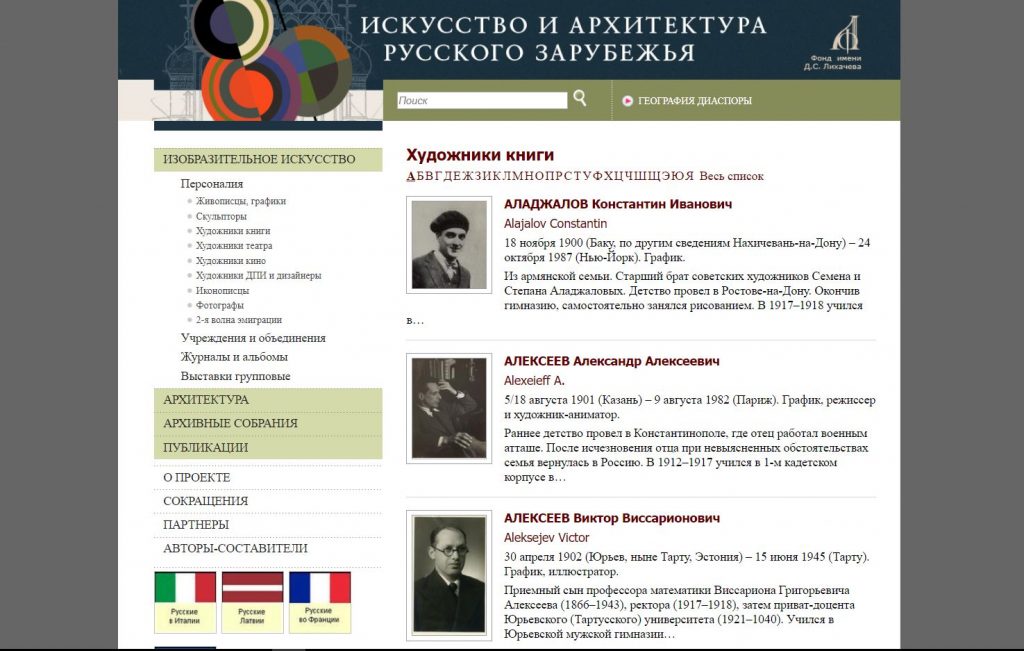
Лейкинд Олег Леонидович, Махров Кирилл Васильевич, Северюхин Дмитрий Яковлевич, Искусство и архитектура русского зарубежья <http://www.artrz.ru> (9. X 2018).
Prezentacija projekta posvećenog umetnicima i arhitektama među ruskim emigrantima. Obiman materijal na sajtu je enciklopedijski organizovan u nekoliko sekcija, a geografski su pokrivene sve važne oblasti i značajni centri ruske emigracije u prvoj polovini XX veka. Isto tako, obuhvaćene su mnogi umetnički pravci: grafika, slikarstvo, vajarstvo, dizajn, pozorište, film, fotografija, a posebno je izdvojena arhitektura crkvenih objekata. Očigledan je odgovarajući doprinos i srpskog saradnika na projektu, Alekseja Arsenjeva, zahvaljujući kome je uvršten i veliki broj odrednica koje pokrivaju razna boravišta ruskih emigranata u Srbiji. Pored biografskih i bibliografskih podataka, sajt sadrži i pretražive informacije o arhivskoj građi, umetničkim udruženjima, grupnim izložbama, savremenim publikacijama. Autori projekta s pravom ističu da je nasledstvo ruske dijaspore sastavni deo ruske kulture, ali da istovremeno pripada i zemljama dijaspore, te stoga služi kao neka vrsta mosta za kulturno približavanje Rusije s drugim zemljama.
Slobodan Mandić, 9. oktobar 2018.
Originalno objavljeno u Godišnjaku za društvenu istoriju 1, 2018, str. 92-93.
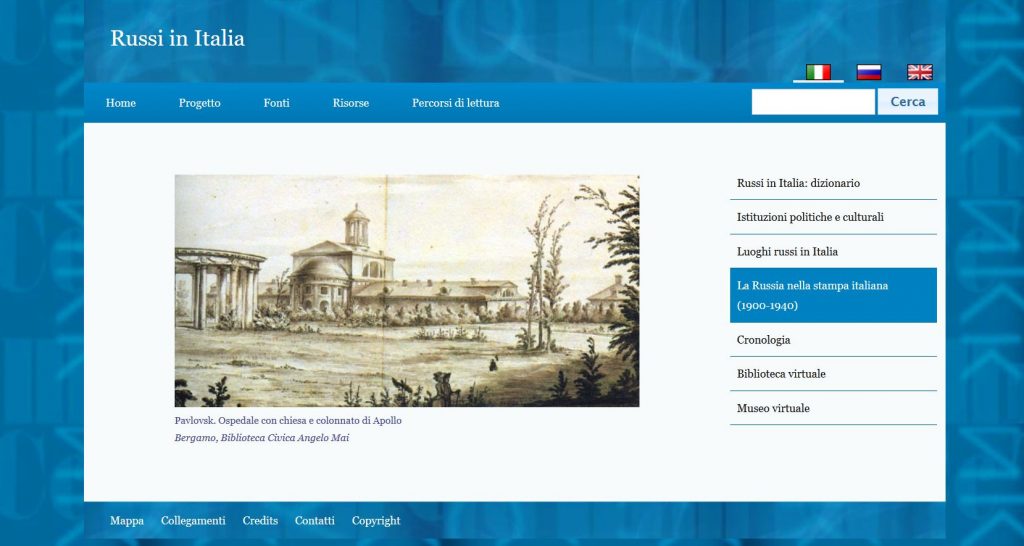
Russi in Italia <http://www.russinitalia.it> (23. XI 2017).
Sajt projekta Rusi u Italiji, finansiranog od strane italijanskog Ministarstva kulture, pokrenula je grupa slavista sa četiri italijanska univerziteta u svrhu upoznavanja sa ruskim prisustvom u Italiji u prvoj polovini XX veka, kao i sa namerom osvetljavanja veza Rusa sa italijanskom kulturom i društvom. Autori sajta ističu da je posebnost ruske emigracije u Italiji u odnosu na ono što se dešavalo u drugim mestima ruske dijaspore, na primer u Francuskoj, Nemačkoj ili u slovenskim zemljama, to što je taj migracioni tok rasut i sakriven u naborima italijanskih kulturnih događaja prve polovine XX veka, i kao takav do sada nije bio predmet sistematskih studija, već samo ciljanih istraživanja pojedinaca ili institucija. Stoga ova prezentacija ima za cilj i da popuni tu prazninu, stvarajući onlajn referentni alat koji će sadržati najveći broj korisnih podataka u ukupnoj rekonstrukciji ovog fenomena. U skladu sa tim skrećemo pažnju na odeljak posvećen izvorima iz fondova arhiva, biblioteka i privatnih zbirki, kao i na deo koji sadrži bibliografiju, gde je mnoge naslove moguće i preuzeti. Osim toga, u okviru menija sa desne strane nalaze se korisni dodaci ka što su biografski leksikon Rusa u Italiji, Hronologija (1900-1943), virtuelna biblioteka i muzej. Virtuelna biblioteka sadrži veliki broj dokumenata, publikacija i novinskih članaka, dok je u okviru muzeja predstavljen značajan broj ruskih umetnika i njihovih radova.
Slobodan Mandić, 23. novembar 2017.
Originalno objavljeno u Godišnjaku za društvenu istoriju 1, 2017, str. 99.-100
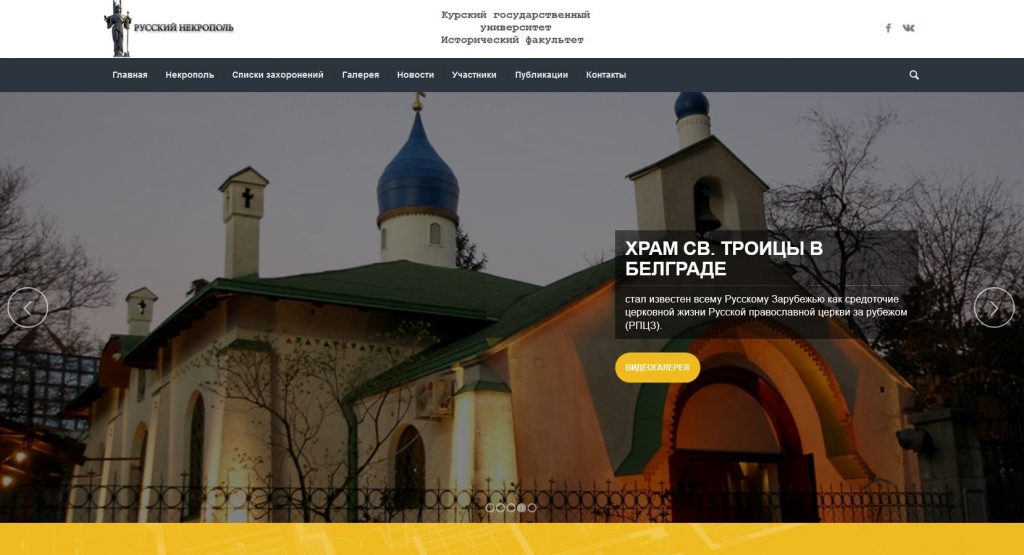
Курский государственный университет, Исторический факультет, Русский Некрополь в Белграде и других городах Сербии <http://rn-belgrade.ru> (25. XI 2017).
Sajt posvećen ruskom groblju u Beogradu i drugim gradovima u Srbiji rezultat je rada profesora, postdiplomaca i studenata Istorijskog fakulteta Kurskog državnog univerziteta, uz podršku kolega sa tehničih fakulteta. Osnovna odeljak sajta sadrži bazu podataka ruskih grobova, koja se može pregledati azbučnim redom, ili unošenjem imena ili prezimena u polje za pretragu. Svaka ličnost u bazi sadrži podatke o premunulom, lokaciji grobnog mesta i fotografiju nadgrobnog spomenika. Navedeno je i ime grada, ako osoba nije sahranjena u Beogradu. U okviru posebne stranice su dati spiskovi sahranjenih po mestima (Beograd, Pančevo, Novi Sad, Zrenjanin, Kragujevac, Kraljevo, Smederevo) i njih je moguće preuzeti na lokalni uređaj za dalje korišćenje. Osim toga, prezentacija sadrži i galeriju fotografija, kao i rubrike o aktuelnim dešavanjima, učesnicima i saradnicima projekta i njihovim publikacijama na temu kojoj je posvećen sajt.
Slobodan Mandić, 26. novembar 2017.
Originalno objavljeno u Godišnjaku za društvenu istoriju 1, 2017, str. 99.
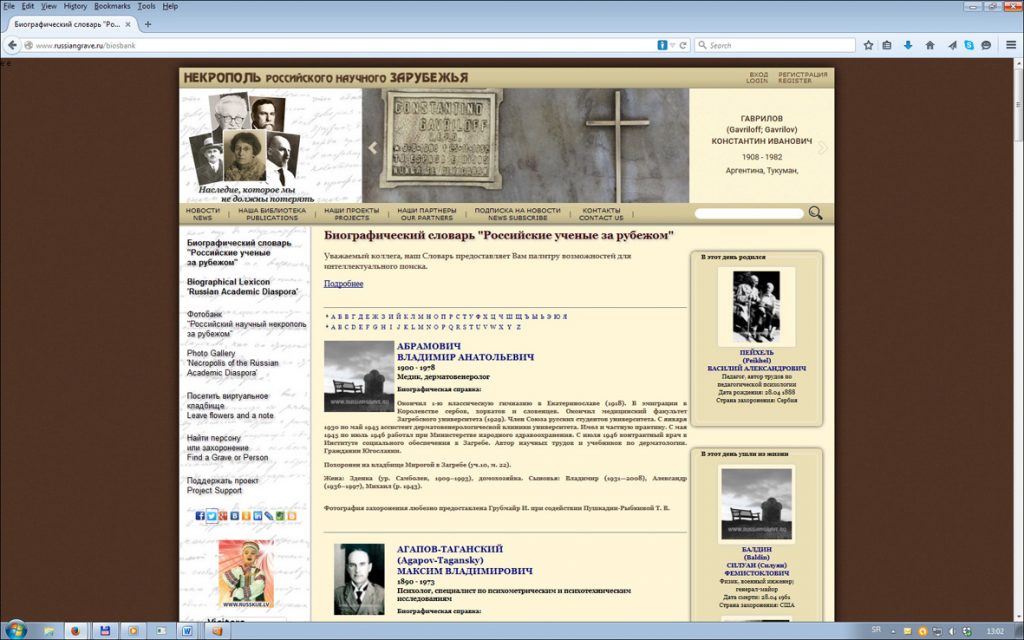
Марина Ю. Сорокина, Наталья Ю. Масоликова, Некрополь российского научного зарубежья, <http://www.russiangrave.ru> (20. IV 2015).
Obzirom na kolosalni značaj koji je ruska emigracija ostvarila na ovim prostorima u mnogim oblastima intelektualnog rada u perioduizmeđu dva svetska rata, prezentacija projekta posvećenog istraživanju ruske naučne dijaspore svakako će pobuditi značajnu pažnju domaće publike. Autorke projekta, saradnice Doma ruske dijaspore Aleksandra Solženjicina iz Moskve, koncipirale su sajt na veoma jednostavan i pregledan način. Osnovu prezentacije čine biografski rečnik ruske naučne dijaspore i baza fotografija grobova ruskih naučnika rasutih širom sveta. Opcija napredne pretrage pruža mogućnost jednostavnog pronalaska željene ličnosti, ili fotografije groba. Među stotinama naučnika koji su do sada uvršteni u bazu, veoma je jednostavno identifikovati one koji su veliki ili značajan deo svog profesionalnog angažmana ostvarili u Beogradu ili nekom drugom mestu Kraljevine Jugoslavije.Određen vid sentimentalnog pristupa temi autorke su iskazale ostavljajući mogućnost posetiocima sajta da odaju poštu preminulim naučnicima tako što će položiti virtuelni buket cveća, ili ostaviti lični zapis ispod fotografije njihovog groba. Brojač posetioca sajta na naslovnoj strani očekivano pokazuje značajan broj pristupa, ne samo iz Rusije, već i iz najudaljenijih krajeva sveta.
Slobodan Mandić, 20. april 2015.
Originalno objavljeno u Godišnjaku za društvenu istoriju 3, 2013, str. 167-168.